Showing posts with label Meats. Show all posts

Monday, August 6, 2012

"Amatxu" Style Rabbit (Conejo estilo "amatxu")

Chicken, pork, veal, beef, lamb, goat, and rabbit are some of the meats consumed in Spain. I will go a little bit further and say that rabbit is the equivalent of turkey in the United States in terms of popularity. Every meat store carries rabbit that is young, lean, and tender. I call this recipe "amatxu" style rabbit because it is the way my mom makes it ("ama" is "mom" in Basque and the suffix "txu" is "dear" so "amatxu" means "dear mom"). Cardiologists in Spain recommend rabbit to their patients because of its lean meat.


Ingredients: Marinate overnight or for a minimum of 12 hours

2 pounds rabbit, cut in pieces 
5 garlic cloves, crushed
1 onion
1/2 cup olive oil
1 cup white wine
salt
freshly ground black pepper


Ingredients:

flour for dusting
1/2 green pepper, finely chopped
1/2 red pepper, finely chopped
3 carrots, cut
3 onions, finely chopped
2 garlic cloves, finely chopped
3 tablespoons tomato sauce
chicken broth (if needed)
2 potatoes, chopped
12 artichoke hearts
1 cup peas


Strain the rabbit from the marinade, saving the marinade for later. Dust the rabbit in flour and lightly fry it in a pan. Lay the pieces on a paper towel and save for later.

In a pot, put the onion and garlic and let them cook slowly on a medium to low burner until the onion becomes translucent.  Add the carrots and peppers. When everything is soft, add the tomato and the liquid used to marinate and cook for another 15 minutes. Then remove the mix from the pot and put it in a chinoise, strainer, or blender.  Add the rabbit to the pot and pour the mixed sauce over the rabbit. If the sauce is too thick, add chicken broth. Cook the rabbit for 20 to 30 minutes or until tender. While the rabbit is cooking, fry the cubed potatoes and the artichokes dusted in flour. Add the potatoes, artichokes, and peas and cook for five minutes. ¡Buen provecho!

Friday, May 25, 2012

Pork chops with sunchokes and mushrooms (Chuletas de cerdo con patacas y champiñones salteados)

Here is another recipe featuring sunchokes (Jerusalem artichokes). Even really good pork chops  need a little spark to jazz them up for the table and this is a tasty solution.


Ingredients for the pork chops and marinade:


5 boneless pork chops
olive oil
lemon juice
chopped garlic
salt
pepper


Ingredients for the vegetables:


1 pound sunchokes, cleaned and sliced thinly
1 pound sliced mushrooms
1/4 cup olive oil
2 tablespoons chopped garlic
1/4 cup sliced leeks
1-2 tsp. cornstarch
salt
pepper
parsley


Marinate the pork chops for an hour or more. Boil the sunchokes in water for a few minutes and drain. Then sauté all of the vegetables until tender, season, and stir with cornstarch to thicken.
Grill the pork chops and then top with the vegetables and fresh parsley.  You will love the flavors.


Friday, May 18, 2012

Chicken with rice and vegetables (Pollo con arroz y verduras)

This dish is a combination of chicken and any and every vegetable that we have in the refrigerator -  not enough to make a dish by themselves but the sum of all of them with the rice make for a good and healthy meal. For instance, I had three chicken breasts (not enough for a family of five), a handful of green beans, another handful of peas, some leftover artichokes that I froze and a few black olives. The point is to make a good and fresh dish with the available ingredients. It is popular all over Spain.


Ingredients:

3 skinless chicken breasts, cubed
1 cup green beans, cut in 1 inch pieces
1 cup green peas
1 cup artichoke hearts
1 ear of corn, cut off the cob 
1/2 cup carrots chopped
6 garlic cloves, cut in thirds
1 small can of tomato sauce
2 cups Mexican long grain rice
4 cups chicken broth
4 tablespoons olive oil
salt to taste

In a pan put the olive oil, garlic, carrots and brown. Then add the chicken and brown it as well. Add the rice and stir it until it starts changing color. Then add the tomato sauce and four cups chicken broth, stir, and then add the vegetables. Bring it to boil and lower the heat. Let it cook covered until the rice is loose. Then let it rest for few minutes and garnish with black olives.


Sunday, May 6, 2012

Top Sirloin Steak with Fiddleheads and Garlic Mashed Potatoes (Brotes de helechos con carne a la brasa y puré de patatas al ajo)

There is something about fiddleheads (cola de mono, Spain, costilla de vaca, Chile, or tête de violin, France) that one cannot resist. Maybe it is the smell and taste of the woods, the pine trees. While most people say they taste like asparagus, I find the flavor closer to Swiss chard. I prefer them boiled, steamed, or sautéd with garlic and served by themselves. Today I paired them with a steak and mashed potatoes. While fiddleheads are a good complement to beef, I still think their flavor stands out most when they are served separately.


Ingredients:

1 top sirloin steak (marinated with white wine, smashed garlic and soy sauce, and then grilled)
6 potatoes 
1 garlic head
cream
salt
pepper

Mashed potatoes:

Put water, potatoes (not peeled), garlic (peeled) and salt in a pan. When the potatoes are done remove and peel them. Then mash the potatoes and the garlic together, and taste for salt and pepper. Next add the cream little by little, stirring until you have the consistency you desire. Taste and rectify the seasoning. Put the mashed potatoes in a deep oven proof dish or in a ring, paint the top with butter and put them under a broiler until the top gets brown.

Fiddleheads:

Blanch the fiddleheads in boiling water for 10 minutes or longer if you steam them. Then remove and put them in ice water.  
If you prefer, sauté the fiddleheads with garlic in olive oil or butter.

Marinated steaks:

Marinate the steak for 3 or 4 hours before cooking in a mix of 1/2 cup soy sauce, 1 cup white wine and 6 chopped or smashed garlic cloves. When the charcoals are red, grill the meat about 5 minutes each side. Remove the meat and let it rest for 15 minutes covered with aluminum foil.


Assemble all the ingredients on a platter. Enjoy the earthy flavors of the fiddleheads, the juiciness of the meat and the creaminess of the potatoes - all with a touch of garlic!


Friday, April 27, 2012

Beef Stew Braised in Red Wine (Estofado de carne)

This is a hearty dish of braised or slow-cooked beef with vegetables and a good red "Rioja" wine. It is a favorite of the wine producing regions of Spain and can be served with creamy garlic mashed potatoes.


Ingredients:

2 spoons olive oil
2 pounds beef, cut in cubes
1 large onion
2 large carrots
1 celery stalk
1 garlic head
12 peppercorns
2 spoons flour
4 cups red wine
2 cups beef stock
2 sprigs thyme
2 sprigs rosemary

2 grated tomatoes (optional)
2 potatoes cut in cubes (optional)


Dust the meat in flour and then brown it with two spoons of oil in a deep oven-proof pot. (Do in batches if necessary.) Remove the meat as it gets brown and set aside. In the same pot add the peppercorns and vegetables and and let them sweat. Then add 1/2 cup wine to get the caramelized juices left in the pan from the meat, and stir.  Return the beef to the pot and add the rest of the wine, the beef stock and the aromatics (thyme and rosemary). Bring to a boil and then put it covered in a preheated oven at 375˚ for 2 hours or longer until the meat is tender. When cut with a fork it should fall apart. Let the stew rest for a few minutes and serve with mashed potatoes or parsnip puree and slices of bread.


Tuesday, April 24, 2012

Stuffed Pork Tenderloin with Roasted Apples (Lomo relleno con manzanas asadas)

I remember my grandmother used to make a pork tenderloin stuffed with dried prunes and served with a very exquisite sauce. While I was thinking of that dish, and memories of my childhood, I had a little detour down memory lane and ended up recalling a favorite "merienda" (afternoon snack) of "quesitos" "El Caserio" (soft cheese) spread on a piece of bread and topped with apples. In turn, I decided to stuff a tenderloin with Serrano ham, "Laughing Cow" cheese (the Spanish "El Caserío" version of this cheese got the idea from them), apples, mixed greens and pistachios.


Ingredients:


2 pound pork tenderloin, butterflied
6 slices Spanish Serrano ham
1 box original Laughing Cow cheese
1 large pink lady apple, cut in julienne
mixed greens
24 pistachios
salt and pepper to taste
2- 3 tablespoons olive oil
1/2 tablespoon flour
1 cup moscato wine
4 apples, cut in halves or quarters
butter


Butterfly the pork or ask the butcher to do it for you. On top of the pork lay the ham, cheese, apples, greens, and pistachios. Roll the pork and tightly tie it with butchers twine. In a deep pan put about 2 to 3 tablespoons olive oil and brown the pork. Remove the pork from the pan, put it on a baking sheet, cover with aluminum foil and bake at 350˚ for about 40 minutes. 
Deglaze the pan used to brown the pork, add 1/3 cup wine and let it reduce. Then add the flour and the rest of the wine, stirring until the sauce thickens. 
During the last 15 minutes, put the apples brushed with butter in the oven. While they are cooking, let the pork rest and then slice it. Serve on a platter with the apples and the sauce. 

Sunday, April 22, 2012

Chicken Breasts with Lemon Sauce (Escalope de pollo al limón)


This dish works equally well with chicken or turkey. It is a favorite with kids and big people too!


Ingredients:

4 chicken breasts, sliced in thin pieces
1 1/2 cups flour
1/3 cup grated parmesan cheese
3/4 teaspoon nutmeg
salt
pepper
2 eggs, well beaten
olive oil
1/2 stick butter
chopped parsley
3 tablespoons lemon juice
capers

Mix the flour, cheese, nutmeg, salt and pepper in a bowl. Dust each chicken piece in this mixture, then dip in the egg and then dust again in the flour.  Place olive oil in a pan and cook the chicken pieces on medium-high heat until brown on both sides. 
For the sauce, melt the butter with the parsley and then add lemon juice and capers. Stir well and spoon over the chicken.


Saturday, April 14, 2012

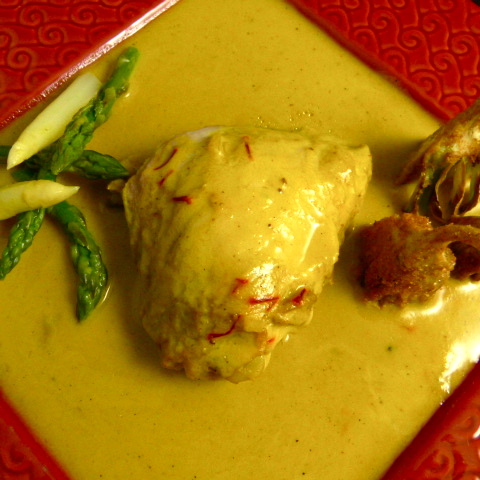
Chicken with Saffron Sauce (Pollo con salsa al azafrán)

One of the great star spices of Spain is saffron ("azafrán"), as we mentioned in previous entries. Saffron is the stigma from the crocus flower and every flower has three stigmas. The bulbs are underground for three years. After this period the bulbs are removed from the ground, leaving the soil to rest for 10 to 15 years and moving to another plot to plant back the best bulbs and discard the worst. The stigmas are picked by hand, making it a very laborious process since to get a kilogram you need about 200,000 flowers and then the stigmas have to dried. All of these reasons make saffron the most expensive spice in the world. Fortunately, you only need a small pinch or a few threads to infuse flavor and color to any dish. The best quality saffron has to be an intense red.


Ingredients:

1 thigh, chicken breast or leg per person
2 tablespoons olive oil
2 carrots, cross cut
1 leek, cross cut
2 garlic cloves, chopped
1 medium onion, chopped
1 pinch saffron
1 glass of white wine
2 cups chicken stock

green asparagus
white asparagus
artichokes
1/2 cup flour mixed with smoked paprika

In a pot, brown the chicken with olive oil and  remove it. Lower the heat, add the onion, carrots, leek and garlic and let them poach. In the meantime toast the saffron (be careful not to burn), remove it and add to warm chicken stock. When the onions are translucent, add the chicken and wine and let the sauce reduce. Stir with a wooden spoon to get all the juices of the chicken and then add the saffron with the chicken stock to the pan. Simmer until the liquid reduces to half.

Remove the chicken. Blend the sauce and then add it to the chicken. Serve with white and green asparagus and deep fried artichokes previously dusted with wheat flour and smoked Spanish paprika.


Saturday, March 24, 2012

Osso Buco (Osobuco)

Osso buco is a cross cut veal shank. Although originally from Milan, Italy, this dish is very popular in Spanish cuisine. While in Italy it  is served with risotto or gremolata, in Spain it is served with rice or mashed potatoes. Osso Buco means "a hole in the bone" because the bone has bone marrow, which is delicious, delicate also eaten. The Spanish spelling is Osobuco.


The original recipe is made with white wine. However, many people prefer to use red wine and enrich the flavor with beef stock. In my hometown, the restaurant "El Cojo" used to make amazing osobuco.


Ingredients:

2 veal cross cut shanks or 1 per person
2 large carrots, sliced
1 large leek, sliced
1 red onion, finely chopped
1/2 pound ripe tomatoes, cut in cubes
2 glasses white wine
2 cups brandy
2 cups water, chicken stock or beef stock (I use chicken stock)
olive oil
flour
salt 
thyme


Dust the meat in flour, add to a sauté pan with hot olive oil and brown the meat. Remove the meat from the pan and place in a pot. In the same pan where you cooked the meat, add the carrots, leeks and onions. Sauté just to get the juices of the meat and then add the vegetables to the pot. When hot, add the brandy and let it burn. Then add the wine and cook for a few minutes to burn the alcohol. Next add the tomatoes and the thyme. Finally add 2 cups of water, chicken stock or beef stock. Reduce the burner to low and let it simmer for two hours or until the meat is tender and falling from the bones. Remove the meat from the pot and let the sauce simmer longer to reduce. Then take the sauce out of the pot and strain it with a chinoise and pestle or a strainer and spoon. Return the meat and sauce to the pot and simmer for another 20 to 30 minutes. 
This type of dish it is always better when made in advance. Serve the meat on a platter with fried cubed potatoes and pour the sauce over the meat.


The bone marrow ready to go over a crostini.

Sunday, March 18, 2012

Grilled Lamb Chops with Alioli, Artichokes and Fan Potatoes (Costillitas de cordero a la brasa con alcachofas y alioli)

This is a traditional dish from Spain and if we add the alioli and artichokes we make it in the style of Catalonia. The chops are from New Zealand but the organic artichokes are from California. We just bought them in our "Just Local Foods Co-op."


Ingredients:

2 New Zealand lamb racks each with 8 chops 
3 mint sprigs, minced
2 rosemary sprigs, minced
2 garlic cloves, minced
salt

For the recipes below:

8 artichokes, peeled and cut in halves
1 potato per person cut in the form of a fan

To marinate:

Cut the racks in individual chops. Make a marinade with the mint, rosemary, garlic and a bit of salt. Rub the chops well and put them in a baggy. Close it and keep overnight in the refrigerator.

For the alioli:

2 egg yolks
2 garlic cloves
olive oil
a couple of drops fresh lemon juice
a pinch of salt

In a blender at the lowest speed, put the egg yolks and garlic and then pour in the olive oil little by little until it thickens, creating the consistency of mayonnaise. Add the lemon juice and salt, blend 1 more minute and pour the mix in a serving bowl.

For the artichokes:

Clean the outside leaves until you get to the tender white leaves. Cut off the green of the stem and the top green of the artichokes and 
discard. Cut the artichokes in halves.

While the potatoes are cooking in the oven (see below), put the artichokes (drizzled with olive oil and a pinch of salt) in an aluminum pouch on a grill over hot coals. After 10 minutes, turn the pouch over and add the lamb chops to the grill. Turn the chops once to grill on each side. Remove the chops and artichokes when done.

For the fanned potatoes:

4 large potatoes, peeled
3-4 tablespoons olive oil
salt and pepper
sweet Spanish paprika

Slice the potatoes lengthwise into 1/4 inch slices to within 3/4 inch of the bottom. Carefully spread the slices open in a fan shape and brush both sides with olive oil. Sprinkle the potatoes with salt, pepper and paprika. Bake at 400˚ for one hour or until tender and brown, basting occasionally with more olive oil.


Arrange on a platter the chops, the artichokes and the fan potatoes. Drizzle with alioli, or serve the alioli in a small bowl.

Wednesday, February 29, 2012

Baked Goat with potatoes (Cabrito al horno con patatas panaderas)

"Cabrito" is another dish that Spaniards eat for Christmas or Easter. We used to eat it around Christmas when the owner of some goats would give us a goat as a present. My family had a piece of land with pine trees and we let him keep his goats there. His goats would eat the brush and this was great for us because then the land was clear. As a token of appreciation he would give us a live baby goat. This was a problem because as kids we would love the cute animal. I found goat meat in a Mexican store in town. They call it "chivo".


Ingredients:


2 1/2 pounds goat, cut in pieces
3 sprigs mint
2 sprigs rosemary
8 garlic cloves
2 sprigs thyme
salt and pepper to taste
2 large onions cut in julienne
3 large potatoes, cross cut
1/2 cup olive oil 
1 large glass white wine
Chicken stock


In a blender mix the mint, rosemary, garlic, and salt and grind everything. Rub the goat pieces with the mixture from the blender and let it rest overnight inside a bag.


The next day, cut the onions and the potatoes. In a pan make a bed with the potatoes and then the onion. Add the wine and the olive oil, season with salt and pepper, and lay the goat over the onions and potatoes. Put uncovered in the oven at the highest temperature for 30 minutes and then lower to 350˚ until tender and the meat is falling from the bone. Once in a while, baste it to make sure that doesn't get dry, If that is the case, add chicken stock.

Tuesday, February 28, 2012

Veal Scallopini (Escalope de ternera)

I remember that when we were little we ate more veal than beef. One of our favorites was "escalope de ternera." It can be just breaded or with a sauce, like the one we made with lemon and capers (check the recipe for sole with lemon and capers to see how to make the sauce). I like it plain with a good tomato and garlic salad and chips. These tomatoes were from Just Local, an organic store. They were delicious.


Ingredients:


1 veal fillet per person, tenderized 
tomatoes
1 potato per person to make the crinkle chips
white wine
garlic
spices
salt
1 egg
breadcrumbs
olive oil


With a mandolin make the crinkle potatoes. If you don't have one just cross cut the potatoes very thin. Cut the tomatoes in half. Tenderize the meat with a tenderizer or a heavy pan. Marinate the veal with a glass of wine, garlic and olive oil for a couple of hours. After that pat it dry, dip in egg then in breadcrums and repeat this.


Cook the potatoes in a fryer, and the meat in a  pan with hot oil until brown.

Monday, February 13, 2012

Port Pork tenderloin (Solomillo de cerdo al oporto)

This recipe for pork tenderloin should be done with a sweet wine like a "Pedro Ximenez" or in this case a port with grapes and raisins. 


Ingredients:

2 pork tenderloins
4 tablespoons olive oil
1/2 cup port
1 cup fresh grape juice
1 cup chicken broth 
1 tablespoon corn starch
1/2 cup raisins presoaked in water
salt and pepper

onion finely sliced and fried to garnish the dish
grapes for garnish

steamed asparagus

for the mashed potatoes:

6 big yukon gold potatoes cut in cubes
1 garlic head
salt
cream

Sear the tenderloins in olive oil on high heat and remove from the pan. Add the port to the pan, the grape juice, add the tenderloins and cook on low heat for about 20 minutes. Then add the corn starch diluted in the cup of chicken broth. Let it reduce about ten minutes and then add the raisins. Remove the tenderloin, and let the sauce reduce more to your likeness. 

Serve on a platter with the sauce, grapes, green asparagus, mashed potatoes, and fried onions.


Sunday, February 12, 2012

Veal Fricassee (Fricandó de ternera)

"Fricandó"  is a traditional Catalan fall dish of veal and a sauce made of onions, garlic, carrots, tomatoes and wine, with thyme, rosemary, and fall mushrooms. It is cooked slowly on low heat.


Ingredients:


6  veal steaks
flour
2 onions finely chopped
4 garlic cloves finely chopped
1 large carrot sliced
6 ripe grated tomatoes
1/2 cup red wine
2 boxes shiitake mushrooms (for lack of fall mushrooms)
2 boxes oyster mushrooms (for lack of fall mushrooms)


For the picada:


one handful pine nuts
2 slices of fried bread
1 garlic clove
parsley
salt
2 tablespoons chicken stock


Mix all the picada ingredients in a blender or mortar and reserve.


Flour the steaks and sear them in a pan with hot olive oil. When they are brown, remove them from the pan and reserve. In the same pan make the sofrito add the onion, garlic, and carrots and simmer until the onion turns translucent. Then add the grated tomato and as they start reducing add the wine. Cook everything until the mix is reduced. Put the mix in a blender and pureé.


Return the steaks to the pan, add the mushrooms, and put the sofrito (the mix from the blender) on top of the steaks. Let it cook for about an hour on low heat with the lid on or until the steaks are very tender to the touch of a fork. If you need more liquid, add chicken stock. To finish, add the picada and cook for another 10 to 15 minutes.

Thursday, February 9, 2012

Talo con Chorizo y Morokil (Corn Porridge)

TALO is like a "tortilla" in México and Central America or "arepas" in Venezuela and Colombia. They say the secret to a good "talo" is in the corn and the flour. During the XVI century many Basque people went to the Americas on expeditions. The Basque Country is mountainous, wet, and humid, with a lot of rain. For those reasons, there was not an area to grow wheat. In the Americas the Basque discovered corn. Bringing it and adapting it to the Basque Country was easy. They started harvesting corn to feed the animals and to grind in mills as flour. The "talo," or Basque bread, helped during winter months because people could avoid going hungry; it is very filling. Another use of the corn flour is to make "morokil," a mix of corn flour and milk to make porridge. The biggest difference with tortillas is the use of hot water. In the Americas they grind the corn by hand with a stone mill. In the Basque Country there are barely any functioning mills left.


This dish reminds me of my "tías" Eulalia and Josefín. I can picture them cooking "talos" and eating "morokil" for supper or breakfast. At school they used to reward us with a medal pinned onto our uniforms. My reward at home was a merienda of "talo" with chorizo, courtesy of "tía" Eulalia for going home with a medal. Sometimes I used to borrow a medal just to get a "talo." Once the daily bread, today it is the "hamaiketako," the eleven o'clock lunch during fairs and festivals, such as the day of "Santo Tomás" or "San Blas." At least we are keeping the tradition alive!


3 cups corn flour (yellow - amarilla)
hot water
salt
chorizo, txistorra, morcilla, bacon, etc...


Put the flour and salt into a bowl and add hot water from a kettle little by little. Stir, until it gets to be a mix like Play-Doh (humid and flexible). Make a ball and then put it on a wood surface. Dust with flour and pat it down, forming a circle. Place the "talos" in a hot pan. When done on both sides, serve with chorizo (boiled in beer or wine,) morcilla or bacon.


MOROKIL


The "morokil" is another traditional Basque dish. It is made with corn flour and hot milk, and it is usually eaten for breakfast or supper.


Ingredients:

1 cup corn flour (yellow-amarilla)
2 cups hot milk boiled with cinnamon and lemon peel
1 tablespoons brown sugar
agave honey or regular honey
wild fruits for toppings

The original dish didn't have cinnamon or fruits. A simple filling dish and an alternative for celiacs. 


Wednesday, February 8, 2012

Pigs Feet (Manitas o patitas de cerdo)

This is another traditional Spanish dish and in every region it is made in a different way. I made the pigs feet "Catalan style." I call this dish Catalan style because it is done with the famous "picada," which is a mix of a couple of slices of fried bread, garlic, almonds, pine nuts, a couple tablespoons of chicken broth and salt to help mash all the ingredients in a mortar.

During times when food was not abundant, when there were not large stores or supermarkets, and  before the industrial revolution that created work in factories, many people were farmers and they had to use everything or most parts of the animals they slaughtered in order to survive the winter months. This dish is one such example.


Ingredients:

2 lbs. pigs feet
2 red onions finely chopped
1 tablespoon olive oil
5 ripe grated tomatoes 
2 large carrots sliced thin
1 dried cayenne pepper

1/2 glass white wine
3 cups chicken stock (low in sodium)
12 toasted marcona almonds
1/2 cup pine nuts
2 slices fried bread
5 garlic cloves
a pinch of saffron
salt and pepper
2 potatoes cut in cubes

In a deep 2 quart pan put the pig's feet to boil. After an hour remove them from the pan and discard the boiling water. Add clean water to the pan and then the pigs feet and boil them on  medium heat for three hours or until tender.

While the pigs feet are cooking, start the sofrito in a pan by cooking the onions, cayenne pepper and carrots in olive oil until the onions turn translucent. Then add the tomato and cook until the sauce starts thickening and the carrots are tender. Remove from the pan, put in a blender and puré. 

Put the pig's feet in the same pan that you used to cook the sofrito. Pour the puré over the pig's feet, add the wine, and cook for about 5 minutes. Then add the chicken stock and let it reduce. 

While it is cooking, make the picada. The original picada was done in a mortar but I use a blender to puré the marcona almonds, pine nuts, fried bread, garlic, a pinch of saffron, about 1/2 cup chicken stock, salt and pepper. Pour the picada over the pig's feet and let it cook on low heat for about 30 minutes until the sauce starts thickening. Fry the potatoes and add to the pig's feet. They are just delicious!